How to Journal Your Trades
We are reader-supported. When you buy through links on our site, we may earn a commission (see affiliate policy).
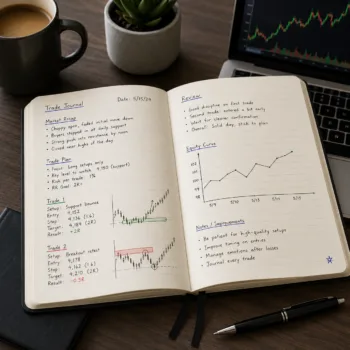
A trading journal is one of the simplest ways to improve as a trader. It helps you track your trades, review your decision-making and find patterns in your wins and losses.
Most traders focus on entries, indicators and setups. That matters, but it is only part of the process. If you do not track what you are doing, you are mostly guessing. A trading journal turns your trading activity into data you can actually review.
In this guide, we’ll cover how to journal your trades, what to include, which mistakes to avoid and how to use your journal to become more consistent.
What Is a Trading Journal?
A trading journal is a record of your trades and the thinking behind them. It usually includes the ticker, entry price, exit price, position size, profit or loss, setup type, screenshots, notes and trade review.
The goal is not just to record numbers. The real value comes from reviewing your behavior. A good journal helps you understand why you entered a trade, whether you followed your plan and what you should do differently next time.
You can journal trades in a spreadsheet, notebook or dedicated trading journal platform such as Tradervue. The tool matters less than the habit. The important part is recording trades consistently and reviewing them honestly.
Why Trade Journaling Matters
Trading is noisy. One good trade can lose money and one bad trade can make money. Without a journal, it is difficult to know whether you are improving or just getting lucky.
A trading journal helps you answer important questions:
- Which setups are actually profitable?
- Which times of day produce your best trades?
- Are you cutting winners too early?
- Are you holding losers too long?
- Are you trading too large?
- Are you overtrading after a loss?
- Do you perform better with momentum, reversals, breakouts or pullbacks?
- Are your best trades coming from planned setups or impulsive entries?
Most traders do not lose because they lack another indicator. They lose because they repeat the same mistakes without measuring them. A journal makes those mistakes visible.
What to Include in a Trading Journal
A useful trading journal should include both trade data and trade notes. Numbers show what happened. Notes explain why it happened.
Basic Trade Details
Start with the basic information for every trade:
- Date
- Ticker symbol
- Market or asset class
- Long or short
- Entry price
- Exit price
- Position size
- Stop-loss level
- Profit target
- Profit or loss
- Fees and commissions
- Trade duration
This gives you the raw data needed to calculate performance and review patterns later.
Setup Type
Every trade should have a setup label. This helps you identfy which strategies actually work for you.
Common setup labels include:
- Gap and go
- VWAP pullback
- Opening range breakout
- High relative volume momentum
- Breakout continuation
- Support bounce
- Resistance rejection
- Mean reversion
- Earnings momentum
- News catalyst trade
If you use scanners, this is especially important. For example, you may find that your high relative volume trades perform better than your low-float breakout trades. Without labels, you will not know.
For related concepts, read our guides on relative volume and VWAP.
Reason for Entry
Your journal should explain why you entered the trade. This is where many traders expose weak decision-making.
Good entry notes might include:
- Stock was above VWAP and holding high relative volume
- Clear news catalyst before the open
- Breakout above premarket high with volume confirmation
- Pullback held previous support
- Strong sector momentum
- Clean risk level below consolidation
Bad entry notes usually sound like this:
- Looked strong
- Everyone was talking about it
- I did not want to miss it
- It was moving fast
- I thought it had to bounce
If the reason for entry is vague, the trade was probably not planned well enough.
Reason for Exit
Many traders spend time planning entries but almost no time reviewing exits. This is a mistake. Your exit often matters more than your entry.
Record why you exited:
- Hit profit target
- Stopped out according to plan
- Price broke VWAP
- Momentum faded
- Volume dried up
- Failed breakout
- Exited too early because of fear
- Held too long and gave back profits
- Moved stop emotionally
This helps you see whether your exits are disciplined or emotional.
Screenshots
Charts are one of the most valuable parts of a trading journal. Add screenshots of your trade before entry, during the trade and after exit if possible.
At minimum, capture:
- The chart at entry
- The chart at exit
- Your entry and exit levels
- VWAP or key moving averages
- Support and resistance levels
- Volume and relative volume
- Premarket high or low if relevant
Screenshots make reviews much clearer. You will often notice mistakes visually that you would miss by only looking at trade data.
Emotional State
Trading performance is not only technical. Your emotional state affects your decisions, especially if you day trade.
Track things like:
- Confidence level
- Stress level
- Fear of missing out
- Revenge trading
- Fatigue
- Distraction
- Frustration after a loss
- Overconfidence after a win
This may feel unnecessary at first, but it is often where the biggest improvements come from. A trader may have a profitable strategy but still lose money by trading emotionally.
Simple Trading Journal Template
You do not need a complicated journal to start. A simple spreadsheet is enough if you use it consistently.
| Field | Example |
|---|---|
| Date | 2026-05-10 |
| Ticker | ABC |
| Direction | Long |
| Setup | VWAP pullback |
| Entry | $10.20 |
| Exit | $10.75 |
| Stop Loss | $9.95 |
| Position Size | 500 shares |
| P&L | +$275 |
| Reason for Entry | Held VWAP with high relative volume |
| Reason for Exit | Sold into resistance near high of day |
| Mistake | Entered slightly late |
| Grade | B |
The key is to keep the journal usable. If you make it too complicated, you probably will not maintain it.
How to Grade Your Trades
One of the best journaling habits is grading trades based on process, not only profit or loss.
A profitable trade can still be a bad trade if you broke your rules. A losing trade can still be a good trade if you followed your plan and managed risk correctly.
Use a simple grading system:
- A trade: followed the plan almost perfectly
- B trade: mostly followed the plan, minor mistakes
- C trade: weak setup or poor execution
- D trade: emotional trade with clear rule-breaking
- F trade: revenge trade, oversized trade or no plan
Over time, track your performance by grade. Many traders discover that most of their profits come from A and B trades while C, D and F trades destroy their account.
What to Review Weekly
Recording trades is only half the process. The real improvement comes from reviewing them.
At the end of each week, review:
- Total trades taken
- Win rate
- Average win
- Average loss
- Largest win
- Largest loss
- Best setup type
- Worst setup type
- Best time of day
- Worst time of day
- Trades that followed the plan
- Trades that broke the rules
The goal is to find patterns. You might discover that your first two trades of the day are profitable, but your afternoon trades are poor. Or you might find that breakout trades work well while reversal trades lose money.
Once you identify these patterns, you can adjust your trading plan.
What to Review Monthly
A monthly review gives you a broader view of your trading performance. Weekly results can be noisy. Monthly data is more useful for identifying bigger trends.
At the end of each month, review:
- Total net profit or loss
- Profit factor
- Average risk/reward
- Best-performing setup
- Worst-performing setup
- Most common mistake
- Largest drawdown
- Number of rule violations
- Performance by ticker type
- Performance by market condition
Your monthly review should produce clear action points. For example, you may decide to stop trading a losing setup, reduce size during choppy markets or only trade during your best time window.
Common Trading Journal Mistakes
A trading journal only works if you use it honestly. Many traders keep a journal but still fail to improve because they record the wrong things or avoid reviewing uncomfortable mistakes.
Only Tracking Profit and Loss
Profit and loss matter, but they are not enough. You need to know why the trade won or lost. Track setup quality, execution, emotion and whether you followed your plan.
Skipping Losing Trades
Some traders journal winners carefully but ignore losers. That destroys the value of the journal. Losing trades usually contain the most useful information.
Writing Vague Notes
Notes like “bad trade” or “good setup” are not useful. Be specific. Explain what happened, what you saw, what you did and what you should improve.
Not Reviewing the Journal
A journal that you never review is just a diary. The point is to find patterns and make changes. Set a weekly review time and treat it as part of your trading process.
Changing Too Many Things at Once
If you change your strategy every week, your journal data becomes less useful. Focus on one or two improvements at a time. Otherwise, you will not know what actually helped.
Trading Journal Software vs Spreadsheet
You can journal trades manually in a spreadsheet or use dedicated trading journal software. Both approaches can work.
Spreadsheet
A spreadsheet is cheap, flexible and easy to customize. It is a good starting point for most traders. The downside is that you need to enter data manually and build your own charts or reports.
Trading Journal Software
Trading journal software can import trades from brokers, generate reports and make analysis easier. This is useful if you trade frequently and want deeper performance statistics.
Tools like Tradervue can help traders analyze performance by setup, ticker, duration and other metrics. If you are serious about improving, dedicated software can save time.
How to Use a Journal to Improve Your Trading
The point of a trading journal is not to collect data forever. The point is to use the data to improve.
Here is a simple process:
- Record every trade immediately after closing it.
- Add screenshots of the chart.
- Write the reason for entry and exit.
- Grade the trade based on process.
- Review your trades weekly.
- Identify your best and worst setups.
- Remove or reduce the setups that lose money.
- Increase focus on your highest-quality setups.
- Track whether your rule violations are decreasing.
- Repeat the process every month.
Over time, your journal should help you trade less randomly and more systematically.
Best Metrics to Track
Once you have enough trades recorded, start tracking performance metrics. These numbers help you understand whether your trading process is improving.
- Win rate: percentage of trades that are profitable
- Average win: average profit on winning trades
- Average loss: average loss on losing trades
- Profit factor: gross profit divided by gross loss
- Risk/reward ratio: average reward compared with average risk
- Max drawdown: largest peak-to-trough loss period
- Expectancy: average expected result per trade
- Rule violation rate: percentage of trades where you broke your plan
Do not obsess over every metric at the beginning. Start with win rate, average win, average loss and setup performance. Add more detail as your process improves.
Example Trading Journal Entry
Here is an example of a useful trading journal entry:
Ticker: XYZ
Setup: High relative volume VWAP pullback
Direction: Long
Entry: $12.40
Exit: $13.05
Stop: $12.15
P&L: +$325
Reason for Entry: Stock gapped up on news, held above VWAP, pulled back on lighter volume and bounced with increasing buying volume.
Reason for Exit: Sold near premarket high after momentum slowed.
Grade: A-
Lesson: Good patience waiting for the pullback. Could have scaled out slightly better instead of exiting all at once.
This type of entry gives you enough information to review the trade later and learn from it.
How Long Should You Keep a Trading Journal?
You should keep a trading journal for as long as you trade. Even experienced traders benefit from tracking performance and reviewing behavior.
At the beginning, journal every single trade in detail. Once you become more experienced, you may simplify the process, but you should still track performance, setups and rule violations.
The longer you keep a journal, the more useful the data becomes. After 20 trades, you may see some patterns. After 100 trades, you have much better information. After 500 trades, your journal can show very clearly what works and what does not.
Trading Journal FAQ
What is a trading journal?
A trading journal is a record of your trades, including entry, exit, profit or loss, setup type, screenshots, notes and lessons. It helps traders review performance and improve decision-making.
What should I include in a trading journal?
A trading journal should include ticker, date, entry, exit, position size, stop-loss, profit target, profit or loss, setup type, reason for entry, reason for exit, screenshots and trade notes.
Can I use a spreadsheet as a trading journal?
Yes. A spreadsheet is a good way to start journaling trades. Dedicated trading journal software can be useful later if you want broker imports, charts and deeper performance reports.
How often should I review my trading journal?
You should review your trading journal weekly and monthly. Weekly reviews help spot recent mistakes, while monthly reviews show broader performance patterns.
Does journaling trades make you a better trader?
Journaling can help you become a better trader if you use it honestly. It helps identify mistakes, profitable setups, emotional patterns and rule violations. The value comes from reviewing the journal and making changes.
Final Thoughts
A trading journal is not exciting, but it is one of the most useful tools a trader can build. It helps you stop guessing and start measuring your actual performance.
The best journal tracks more than profit and loss. It records your setup, reasoning, execution, emotions, screenshots and lessons. Over time, this helps you find your best setups, remove weak trades and reduce emotional mistakes.
If you are serious about trading, start journaling every trade. Keep it simple, review it weekly and use the data to improve your process. The goal is not to trade more. The goal is to trade better.
Related articles: Tradervue Review, Relative Volume Explained, VWAP Explained, Trade Ideas Review.
Journaling tools: Tradervue.